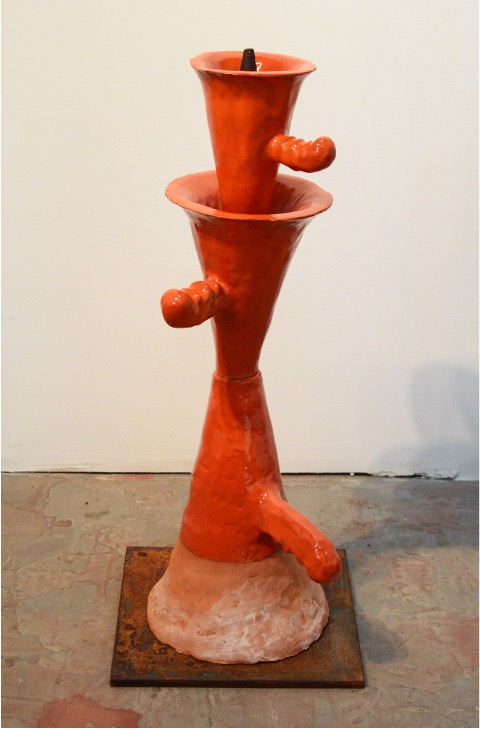
Marcos Vidal's objects immediately elude classical classification through words: do they reveal an objective reality, are they objectively true or are they plastic carriers of an objective perception?
Vidal breaks with conventional ways of looking, as well as with the functional dispositions with which society facilitates its own understanding and general coexistence. He invents laws and rules to guarantee the functionality of objects. But these descriptions of objects are constructions that remain valid until a new invention demands a different truth.
Vidal intervenes in these questions with his works of art by taking up the viewer's familiarity with the individual object, only to immediately question it again. Vidal renews the so-called object art that has excited or scandalised the art scene since the late 1950s.
art scene since the late 1950s.
The credo of the time was: object = objective = real = reality. The ready-made was under the direct control of the artist, who no longer had to make formal considerations. The only thing left to do was to find the right context.
Vidal loves objects. He collects them, saws, cables and pipes, spatulas, electric sockets, tape measures and, with special preference, the wooden blocks that he transforms. Only the direct use of them is forbidden by the new character of the work.
Each subject is a poetisation of the real object and at the same time a critical questioning of functionality and acceptance in the capitalist and commercial world of our society.
The artist's works are therefore not a game, but the result of his own critical experiences with the habits and laws of our society and, at the same time, the embellishment of the object, which now has only one aesthetic life left to live.
because of its new uselessness.
This political interpretation underlies, often hidden, in each of the artist's sculptures, especially when he deals with the different spatulas, or with the oversizing of an electric socket made entirely of wood or the centimetre measurements in wood, therefore unusable, in the work measuring tape.
There are no parallels in the history of Spanish art, but Picasso's bull skull could serve as a model. In this way, Vidal also distances himself from the long tradition of Spanish painting.
The subjective links with the object thus find a new reality. The tools are works of art that are withdrawn from use in order to evoke in the viewer memories, new reflections and other experiences with the familiar object.
In his 1962 essay of the same name, the Italian poet and philosopher Umberto Eco calls this process the ‘opera aperta’, the open work of art, which acquires independence in the mind of the individual viewer in a different way and is completed in a different way.
For each viewer brings his or her own private connotations to the work of art.
Just as Vidal presents his own connotations, in which he processes his experiences with objective reality.
The artist is aware of the fragility of the connotations, but he himself constantly questions the objective reality of each object, the questioning perception, the inner and outer reality.
Objectivity is what is confronted, reproach and counter-reproach at the same time.
In this way, Vidal moves with his objects in real life, in art history, in sociology and in philosophy. His works are interpretative and therefore hermeneutic objects.